
Buying hospital furniture in bulk is rarely as simple as picking models from a product catalogue and comparing unit prices. Whether you are outfitting a newly constructed hospital wing, upgrading public health wards, or stocking a regional medical distribution warehouse, furniture represents a long-term capital investment that directly affects daily nursing workflows, patient safety, and infection control.
Two hospital beds can look nearly identical in a brochure yet perform very differently after six months on a busy ward. Differences in steel thickness, surface pre-treatment, mechanical crank tolerances, or actuator protection often determine whether a bed operates smoothly for years or requires constant maintenance. Furthermore, because medical furniture is bulky, packaging format and container loading efficiency play a major role in your final landed cost.
If you are planning to source bulk hospital beds and ward furniture from India for a healthcare facility or distribution project across Africa or the Middle East, the following procurement guide will help you prepare clear technical specifications and evaluate supplier quotations accurately.
Match Furniture Specifications to Each Clinical Zone
Before contacting a supplier, break down your furniture requirements by clinical department rather than requesting a single generic bed model for the entire facility. Different hospital zones have distinct patient acuity levels, staff ergonomics, and power availability realities.
General Wards vs. High-Dependency and ICU Environments
For general inpatient wards, durability and ease of operation are usually the top priorities. Procurement teams typically select plain hospital beds, semi-Fowler beds (offering backrest adjustment), or full-Fowler beds (offering both backrest and knee-rest adjustment). In regions where electrical grids fluctuate or maintenance teams prefer simple mechanics, manual crank-operated Fowler beds remain the standard choice for general admission wards.
In contrast, High-Dependency Units (HDUs) and Intensive Care Units (ICUs) require rapid positioning for critical care procedures. Five-function electric ICU beds allow nursing staff to adjust backrest angle, knee elevation, overall bed height, Trendelenburg, and reverse Trendelenburg positions via handheld remotes or nurse control panels. When specifying electric ICU beds, buyers should also verify whether the bed includes an instant manual CPR release lever so the backrest can be flattened immediately during a cardiac emergency, even if facility power is out.
| Bed Type | Core Adjustments | Typical Clinical Zone | Key Specifications to Confirm |
| Semi-Fowler Bed (Manual) | Backrest elevation via manual crank | General inpatient wards, observation rooms | Crank fold-away design, over-winding protection, perforated steel mattress base |
| Full-Fowler Bed (Manual or Semi-Electric) | Backrest and knee-rest adjustment (with optional height adjustment) | General surgical wards, orthopedic wards, private rooms | Number of cranks, side rail type (collapsible aluminum vs. ABS), castor lock mechanism |
| 5-Function Electric ICU Bed | Backrest, knee-rest, height, Trendelenburg, reverse Trendelenburg | Intensive Care Units (ICU), Coronary Care Units (CCU), HDU | Actuator IP waterproof rating, rechargeable battery backup, manual CPR release, X-ray translucent backrest |
| Obstetric / LDR Maternity Bed | Backrest, height, Trendelenburg, detachable leg section, lithotomy supports | Labor, Delivery, and Recovery (LDR) suites | Fluid-resistant mattress seal, stainless steel filth basin, grip handles, leg holder adjustability |
Specialty Department Requirements
Beyond standard inpatient wards, a complete facility Bill of Quantities (BOQ) should account for specialized clinical areas. Maternity departments require Labor, Delivery, and Recovery (LDR) beds or obstetric delivery tables built with corrosion-resistant steel and easy-to-clean fluid basins. Pediatric wards need high-railed pediatric cots and clear acrylic infant bassinets to prevent falls and allow continuous visual monitoring.
For surgical suites, buyers should review dedicated ICU and operating theatre furniture, including hydraulic or electro-hydraulic operating tables constructed from AISI 304 stainless steel with radiolucent tabletops for C-arm imaging access. Outpatient departments (OPDs) and emergency triage bays similarly require sturdy examination tables and medical trolleys, such as crash carts, anesthesia trolleys, and instrument dressing trolleys.
Essential Ward Accessories to Include in Your BOQ
One of the most common mistakes in hospital furniture procurement is assuming that a quotation for a “hospital bed” automatically includes the mattress and bedside accessories. Different suppliers bundle accessories differently, which can make one quotation appear artificially cheaper than another.
When preparing your enquiry, specify whether each bed requires:
- Medical Mattress: Confirm the foam density, thickness (commonly 10 cm to 15 cm), sectioning (single-section vs. four-section articulated foam to match Fowler beds), and whether the cover is waterproof, flame-retardant, and wipeable with hospital disinfectants.
- IV Pole: Specify whether a telescopic stainless steel IV rod with two or four hooks should be included, along with pre-welded mounting sockets at the four corners of the bed frame.
- Bedside Locker and Overbed Table: Patients in general and private wards require an ABS or powder-coated metal bedside cabinet for personal and clinical items, alongside a height-adjustable overbed cardiac table for meals and recovery.
Explore Clinivance’s complete hospital furniture range to see how ward beds, storage cabinets, stretchers, and reception seating can be consolidated into a single project list.
Verify Frame Materials, Coating Quality, and Mechanical Durability
Hospital furniture undergoes heavy daily use, frequent movement across corridors, and repeated wiping with strong chemical disinfectants. Specifying the right underlying materials prevents premature rust, peeling paint, and mechanical failure.
Steel Gauge, Pre-Treatment, and Corrosion Resistance
For general ward beds, lockers, and examination couches made from mild steel (MS), the longevity of the frame depends heavily on how the metal is prepared before painting. In humid coastal cities or tropical climates—such as Lagos, Mombasa, Dar es Salaam, or coastal GCC hubs—untreated steel will quickly rust from the inside out.
Buyers should verify that mild steel frames undergo multi-stage chemical pre-treatment (degreasing, derusting, and phosphating) followed by electrostatic epoxy powder coating. Epoxied surfaces resist chipping and stand up better to routine hospital cleaning. For high-moisture environments, sterile supply rooms, operating theatres, and scrub zones, buyers should specify AISI 304 grade stainless steel rather than lower-grade alternatives that may corrode when exposed to chlorine or iodine solutions.
Testing Mechanical Cranks vs. Electric Actuators
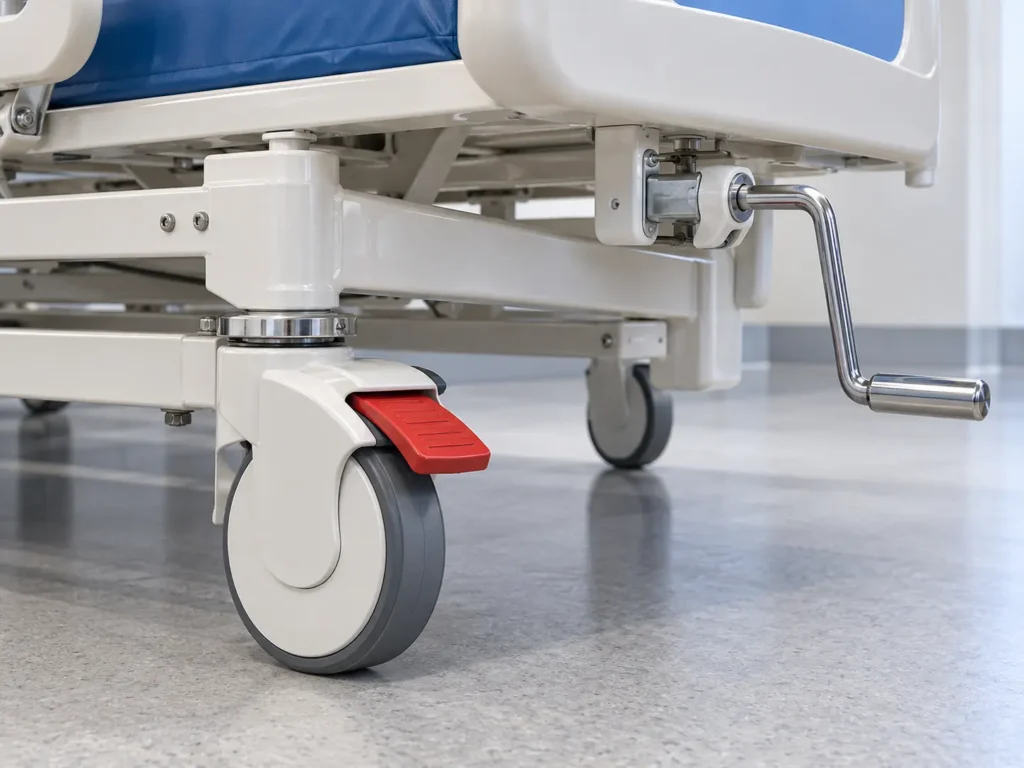
On manual hospital beds, the screw mechanism attached to the folding crank handle takes the brunt of daily wear. Ask suppliers whether the crank mechanism uses a heavy-duty lead screw equipped with an over-winding protection clutch. Without over-winding protection, staff or patient attendants can keep turning the handle past the limit stop, stripping the gears or bending the frame.
On electric and semi-electric beds, focus on the medical linear actuators and control box:
- Ingress Protection (IP Rating): Actuators and control boxes should carry at least an IP54 or IP66 rating so that fluid spills and wet disinfection do not cause electrical short circuits.
- Voltage and Grid Compatibility: Confirm that the power supply matches your country’s voltage and frequency (for example, 220V–240V, 50/60Hz) and includes internal surge protection.
- Rechargeable Battery Backup: Every electric ICU or ward bed should include an integrated rechargeable backup battery. If main hospital power fails, nurses must still be able to lower the bed or adjust the patient’s posture before backup generators come online.
Side Rails, Headboards, and Castor Braking Systems
Review the patient contact points and mobility hardware on every bed configuration:
- Head and Foot Boards: Detachable ABS or polypropylene (PP) boards with secure locking latches allow staff to remove the headboard quickly during emergency intubation or resuscitation.
- Side Rails: Choose between collapsible aluminum alloy rails ( typically 5-bar or 6-bar configurations) and split Four-Piece ABS tuck-away rails. Split ABS rails are widely preferred in ICUs and private wards because they offer fuller patient enclosure and often feature built-in angle indicators so nurses can verify precise 30-degree head-of-bed elevation.
- Castor Wheels and Brakes: Specify the wheel diameter (commonly 125 mm or 150 mm for smooth rolling over floor joints and elevator thresholds) and the braking style. General ward beds typically use individual diagonal foot brakes on two or four wheels, while ICU beds and emergency transport stretchers benefit from a central pedal braking and directional steering system.
Plan Container Loading and Freight Economics Early
Unlike compact pharmaceuticals or surgical instruments, hospital furniture is volume-heavy rather than weight-heavy. In international sea freight, shipping charges are calculated primarily by cubic meter (CBM) volume or full container loads (20ft GP, 40ft GP, or 40ft High-Cube containers). How a supplier packs your furniture can change your landed cost per unit by 20% to 40%.
Knocked-Down (KD) Packaging vs. Pre-Assembled Shipping
Shipping a hospital bed fully assembled with its headboard, side rails, and castors attached consumes a large volume of empty air inside a shipping container. To maximize container capacity, experienced B2B buyers request Knocked-Down (KD) export packaging wherever structural design permits.
In a Knocked-Down configuration, the main mattress platform is packed flat, while detachable ABS headboards, side rails, castors, and crank handles are packed securely in multi-ply corrugated export cartons or wooden crates. Similarly, wheelchairs and patient stretchers can be folded flat, and mattresses can be stacked or vacuum-compressed where appropriate for the foam type. When reviewing a supplier quotation, ask for the estimated CBM per unit and how many complete sets can fit into a 20-foot or 40-foot High-Cube container.
Spare Parts Buffers and Assembly Documentation
Because Knocked-Down furniture requires assembly at the hospital project site or distributor warehouse, buyers should confirm that the shipment includes clear assembly instructions and any specialized bolts or fasteners needed.
For large institutional or tender orders, it is also good procurement practice to request a small buffer (typically 2% to 5%) of high-wear spare parts in the same container. Including extra castor wheels, rubber leg tips, crank handles, IV pole plastic hooks, and actuator handsets in your initial shipment costs very little in extra freight space, yet saves months of downtime if a component is damaged during years of hospital use.

Check Quality Standards and Destination Import Requirements
International healthcare buyers must ensure that imported hospital furniture complies with both clinical safety standards and destination customs rules.
Depending on the classification of the furniture in your target country—particularly for motorized ICU beds, operating tables, and specialized hospital beds and accessories—procurement teams and regulatory authorities may require:
- ISO 13485 Certification: Confirming that the manufacturer operates under a recognized Medical Devices Quality Management System.
- CE Documentation and Safety Testing: Confirming electrical safety and mechanical Safe Working Load (SWL) ratings (especially important for bariatric or motorized beds).
- Pre-Export Verification of Conformity (PVoC / CoC): Markets such as Kenya (KEBS), Tanzania (TBS), Uganda (UNBS), and Nigeria (SONCAP) frequently require pre-shipment inspection and a Certificate of Conformity before goods are loaded or cleared at the destination port. Similarly, importers in Saudi Arabia, the UAE, Oman, Qatar, and Kuwait should confirm whether motorized medical beds require prior listing or device registration with their national health authority.
If your order combines hospital furniture with daily operational supplies—such as disposable bedsheets, examination gloves, or catheters—you can also review our guide on how to plan a bulk medical consumables order from India to organize multi-category export documentation smoothly.
How Clinivance Supports Bulk Hospital Furniture Procurement
Clinivance Healthcare Solutions works with hospital project teams, medical equipment distributors, clinics, and institutional buyers across Africa and the Middle East to source reliable healthcare furniture from India.
Rather than dealing with multiple disconnected workshops for beds, stainless steel trolleys, cabinets, and mobility aids, buyers can share their complete project list or Bill of Quantities with our team. We help match product specifications to your clinical requirements and budget—covering manual and electric hospital beds, ICU and OT furniture, examination tables, stainless steel storage cabinets, wheelchairs, stretchers, and medical refrigeration units.
For new healthcare construction or ward modernization projects, Clinivance also provides clinical design and facility setup services, helping healthcare administrators plan ward layouts, space utilization, and equipment integration from the ground up.
Final Checklist for Bulk Hospital Furniture Buyers
Before submitting a hospital furniture enquiry or requesting a container-load quotation, verify that your procurement list includes the following details:
- Department-by-department product breakdown (General Wards, ICU, Operating Theatre, Maternity, OPD, and Reception)
- Required bed mechanism for each line item (plain, 2-crank manual Fowler, semi-electric, or 5-function full electric)
- Frame material and finish specification (pre-treated epoxy powder-coated mild steel vs. AISI 304 stainless steel)
- Safe Working Load (SWL) requirements and overall frame dimensions
- Side rail configuration (collapsible aluminum rails vs. split four-piece ABS rails) and headboard material
- Castor wheel diameter and braking mechanism (individual diagonal locks vs. central pedal locking)
- Exact accessories required per bed (mattress thickness and cover material, IV pole, bedside locker, overbed table)
- Local electrical specifications (voltage, frequency, plug type) and backup battery requirements for motorized beds
- Preferred export packaging (Knocked-Down/KD packing for container optimization) and spare parts buffer percentage
- Required quality certificates, conformity assessment inspections (such as CoC/PVoC), and destination port details
Sharing a structured specification list allows our sourcing team to calculate accurate container volumes and provide a clear, comparable quotation.